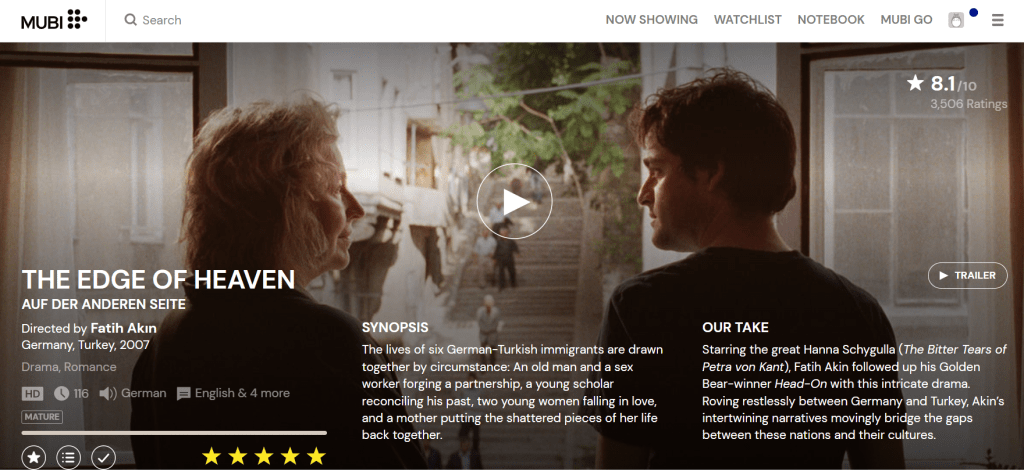
THE EDGE OF HEAVEN, Movie, MUBI

This is the first movie in which I came across a unique craft – seamless flashback.

One can imagine the story like driving on the road for a while and then taking a U-turn. So, while driving one way, the driver will get a view, and after the U-turn, the driver will get the same view, but different perspective. The Point of View changes.

Again, if the driver, while driving up a road, sees an ongoing murder by the side of the road, so, after U-turn, the driver will view that event again from the other side of the road. Well, not exactly the same event but an aftermath, but a murder none-the-less.

The movie blends the story’s forward movement with flashbacks. This method of storytelling becomes clear later in the story when there is a “U-turn” – a time in the movie, a scene, at which a discerning viewer will know that, from now, the story is moving backwards in time and is filling the gaps between certain key past events.

The movie THE EDGE OF HEAVEN features Turkish, German, and some English languages, and it takes place in both countries. There are traces of cultural friction also depicted in the story.

It is a refreshing watch. One expects after story’s “U-turn” that certain key characters should meet. But the story is naughty in not letting it happen. Yet, the ending is peaceful.

#BARBENHEIMER

The movie #Oppenheimer is a 3-hour long collage – random newspaper cutout, pasted on a reel and then, and as if this was not enough, the narration was further compounded by periodic back and forth in story time-line, and again, as if this was not enough, color and black and white scenes at periodic intervals were added into the mix. The final result is one big disarray.

It is understood that a movie about the making of the “Nuclear Bomb” is much too complicated for the lay audience, but then, why add to the confusion with assorted news clippings randomized over the movie timeline?

At the end of it all, no justice was ever done to any of the characters. Most of them are long dead to really bother with this messy attempt to tell their story.

If you have not seen Oppenheimer, skip it. You haven’t missed anything.

Now moving on to the other over-hyped bonanza – Barbie which hit theaters alongside Oppenheimer and thus created the portemantau, – BARBENHEIMER. The movie Barbie is a good attempt by the moviemaker to create an alternate thesis around the cultural significance of the Barbie doll.

The movie is well crafted and has an engaging story. But the only weak point is that it tries to be philosophical at junctures, and in those moments, the dialogues are not convincing.

What Barbie needed was better writing. Because when one is delving into philosophical waters, one needs to be simple and exact and also prepare the audience for a dose of Proust.

Compared with Oppenheimer, Barbie is a better watch.

BYJU and our own attitude to education.

I must admit that when it comes to education, I consider myself incredibly fortunate to have attended St. Mary’s School, Dum Dum, for five years. However, it was not the school itself that made the difference, but rather the exceptional teachers I had. Our school was managed by devoted Christian missionaries, particularly the Irish Christian Brothers, whose teaching standards were unparalleled. Even after going through junior college and university in Mumbai, I never encountered teaching at the same level as I did in school.

This reflection on my education came to mind when I read about BYJU, the struggling self-learning/online education company. Anyone who has experienced self or online learning knows that it’s not as simple as it may seem.

I still recall BIJU’s advertisements on TV during the COVID lockdowns in 2020 and the media’s enthusiasm about its success and the benefits of studying indoors. Having experienced self/online learning myself over the years, I knew that BYJU’s model was not sustainable.

Coincidentally, while BYJU was on the rise in 2020, the government also introduced its New Education Policy, and these two unrelated events led to the widespread belief that online learning is the way forward. This inspired me to share my thoughts and experiences with self and/or online education on my blog in 2020.

“Open” and “Online” do not imply that it’s “Easy.” Self-learning requires tremendous discipline to complete even a single module of a course, and many people may struggle to finish. I have experienced this firsthand.

Self-learning, including online learning, demands an environment that is unfortunately lacking in most Indian households.
–>Is there a dedicated study room?
–>Do students have access to proper equipment?
–>Are children disciplined enough at home to follow the curriculum?
–>How closely are parents supervising their children’s studies versus leisure activities?

As one can imagine, self-learning comes with substantial monitoring costs and a steep learning curve for most Indian parents. If parents had received better schooling and understood effective pedagogy, they would know that students, especially up to class 10, require real classroom interactions with teachers and peers.

However, I believe that online and self-learning should be introduced as a subject in class 8, gradually initiating students into a “teacher-less, class-less, and student-to-student forum” environment so that by class 10 or 12, they can confidently pursue higher education with self-motivation.

The key here is to ensure that the online space does not isolate students but rather connects them in groups with a shared goal of mastering a subject.